
Noida Expressway Real Estate: 2026 Investment Blueprint
Key Takeaways
- Current traffic hits 150,000 PCUs daily, signaling massive commercial occupancy rates.
- Real estate demographics are shifting from mid-income to ultra-luxury asset classes.
- Upcoming Jewar Airport integration transforms this corridor into a global logistics hub.
- Future infrastructure relies on Miyawaki forests, white-topping, and strict FAR adherence.
- Institutional money is aggressively pivoting toward Grade-A data centers here.
If you have deployed capital in the National Capital Region (NCR) over the past twenty years, you already understand that road infrastructure dictates real estate valuations. In our market observations at Rupee Reality, no single piece of tarmac has created more wealth for institutional and retail investors than the Noida-Greater Noida Expressway.
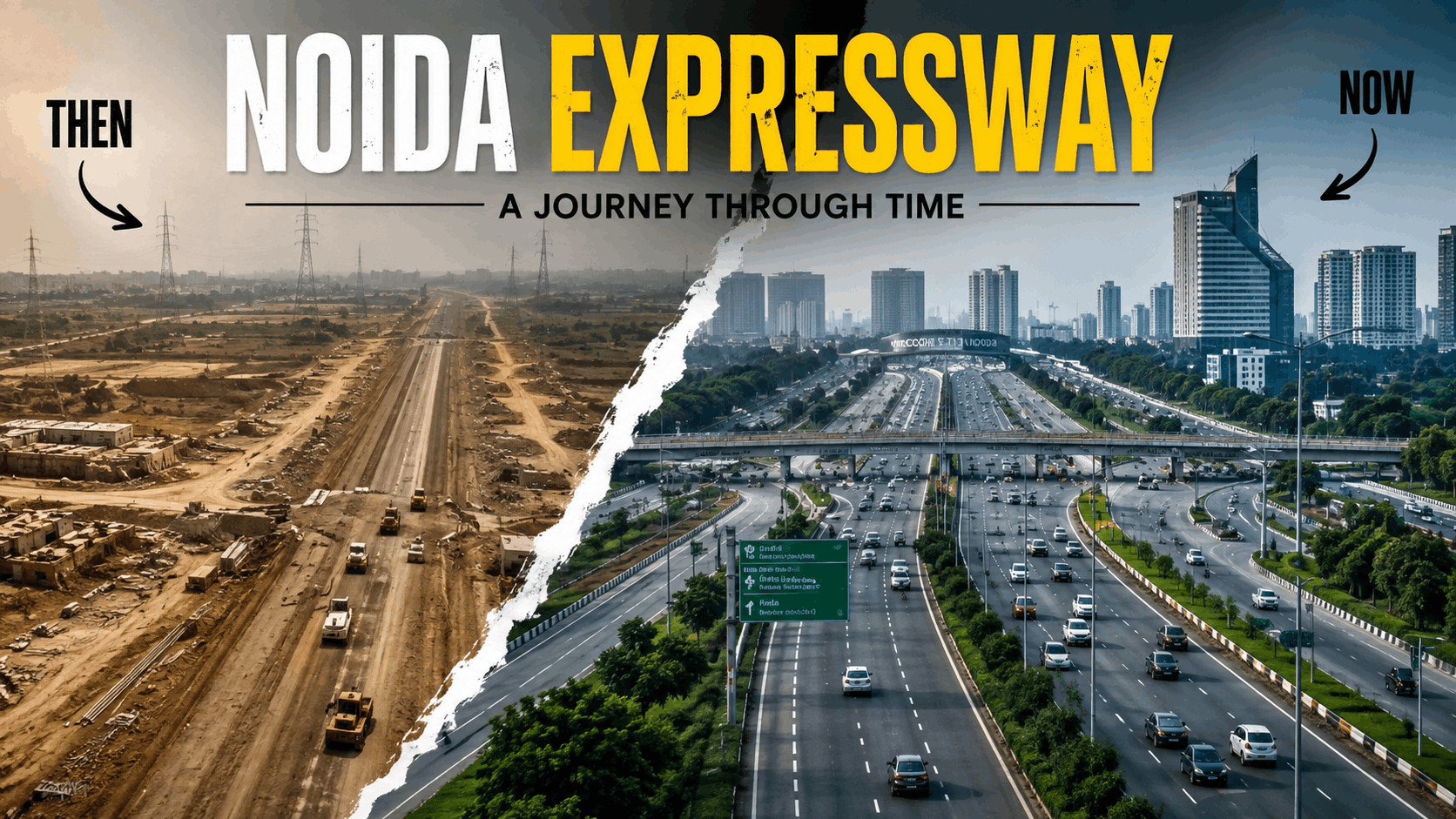
Conceived in the late 1990s, this wasn't just a road—it was a definitive urban planning mechanism designed to decongest the older, choking arterial paths connecting Delhi to western Uttar Pradesh. But as we navigate through 2026, the corridor faces an inflection point. Driven by unprecedented corporate consolidation and the looming shadow of the Jewar International Airport, the investment playbook for the expressway has entirely rewritten itself.
The Genesis: Bypassing the Surajpur-Dadri Bottleneck
Before August 2002, moving logistics or human capital from Delhi to Greater Noida meant suffering a two-hour ordeal through the narrow, chaotic Surajpur-Dadri state road. Institutional investors refused to touch land parcels in Greater Noida due to this severe isolation. The UP Industrial Area Development Act of 1976 allowed the Noida Authority sweeping powers to acquire agrarian land directly across the Yamuna and Hindon river floodplains.
What sets this expressway apart from later developments like the Yamuna Expressway is its funding model. Built for approximately ₹400 crore, it was a wholly state-funded initiative, devoid of early Public-Private Partnership (PPP) debt traps. It debuted as a modern marvel: a six-lane divided carriageway engineered for 120 km/h, flanked by continuous two-lane service roads that segregated high-speed regional transit from local village traffic.
This master-planned foresight completely outmaneuvered the organic, haphazard growth seen in the Delhi-Gurgaon corridor. The government proactively built the infrastructure before the population migrated, resulting in superior grid layouts that are now highly prized by institutional capital.
Current Traffic Dynamics & Commercial Real Estate Dominance
Today, the Noida-Greater Noida Expressway is the undisputed financial artery of Gautam Buddha Nagar. However, success has bred systemic strain. The corridor currently endures between 100,000 to 150,000 Passenger Car Units (PCUs) daily. This massive volume far exceeds its original design capacity, creating brutal choke points—specifically at the Mahamaya Flyover and the Pari Chowk distribution rotary.
Why the massive volume? Look at the sectors immediately bordering the route. Sectors 125, 126, 132, 135, and 142 have evolved into aggressive commercial real estate hubs. Campuses for global giants like Samsung, KPMG, and HCL anchor these zones. The availability of expansive, affordable Grade-A office spaces triggered a corporate exodus from Delhi.
For investors analyzing commercial property investment strategies, the yields here have stabilized, but capital appreciation remains robust. The ongoing integration of the Aqua Line Metro, operational since 2019, has partially alleviated commuter strain by running a parallel elevated viaduct, driving up valuations for adjacent Transit-Oriented Developments (TOD).
| Asset Class | 2002-2010 Phase | 2026 Current Status | Yield Profile |
|---|---|---|---|
| Group Housing | Affordable / Mid-Income | Maturing / High Maintenance | 2.5% - 3.5% |
| Corporate IT Parks | Early Land Acquisition | Near Full Occupancy | 7.0% - 8.5% |
| Data Centers & Logistics | Non-Existent | Aggressive Expansion | 9.0%+ (Institutional) |
The Jewar Multiplier: 2035 Projections and Engineering Overhauls
Looking ahead, the operationalization of the Noida International Airport (Jewar) will permanently alter the expressway's DNA. Traffic is projected to surge past 250,000 daily vehicles. The expressway will transition from a city connector into a vital bridge linking the Delhi-Meerut grid and the upcoming Delhi-Mumbai Expressway network.
To handle this localized freight and passenger explosion, horizontal expansion of the six-lane carriageway is virtually impossible due to the Metro viaduct and rigid property lines. Instead, structural planners are pushing for "white-topping"—a process of laying a thick layer of cement concrete over the aging polymer-modified bitumen to exponentially increase load-bearing capacity.
Urban planning policies are also tightening. To prevent the collapse of local civic amenities, UP RERA and municipal bodies must strictly enforce Floor Area Ratio (FAR) caps. We are also tracking proposals for Personal Rapid Transit (PRT) pod taxis connecting the expressway to Film City, a move that would redefine last-mile connectivity for the ultra-luxury residential complexes replacing early affordable housing segments.
Strategic Due Diligence Workflow for Investors
Analyze Micro-Market FAR Limits
Before deploying capital into commercial plots, verify the specific sector's Floor Area Ratio limits. Sectors zoned for higher density without corresponding underpass infrastructure will suffer severe valuation stagnation due to permanent gridlock.
Assess Metro and Service Lane Access
Properties solely reliant on the main carriageway for entry are facing increased regulatory scrutiny. Prioritize assets with primary frontage on widened service lanes within a 1.5 km radius of an Aqua Line Metro station.
Verify Ecological Zoning Compliance
Environmentalist interventions regarding the Yamuna floodplain are tightening. Ensure your target asset falls cleanly outside the ecologically fragile zones designated for upcoming Miyawaki afforestation projects.
To fundamentally capitalize on this corridor, you cannot rely on outdated historical charts. You must align your portfolio with broader infrastructure development funds focusing on transit-oriented tech hubs. Retail investors attempting to flip residential units will be squeezed; the smart money is holding long-term commercial lease-generating assets.
The transformation of the Noida-Greater Noida Expressway is a textbook case of infrastructure pulling the NCR real estate market forward. The demographic is skewing older, wealthier, and deeply corporate. Position your investments accordingly.
Frequently Asked Questions
What is the current traffic volume on the Noida Expressway?
The expressway currently handles upwards of 100,000 to 150,000 Passenger Car Units (PCUs) daily, which far exceeds its original design capacity, driven heavily by corporate commute cycles.
Is the Noida-Greater Noida Expressway toll-free?
Yes, unlike the adjacent Yamuna Expressway or the DND Flyway, the 24.53 km Noida-Greater Noida Expressway is entirely toll-free for all commuter and commercial vehicles.
Who is responsible for maintaining the expressway?
The Noida Authority handles the civil repairs, horticultural maintenance, lighting, and infrastructure upgrades, while traffic enforcement is managed by the Gautam Buddha Nagar Traffic Police.
When was the Noida Expressway opened to the public?
Conceptualization began in the late 1990s as a master-planned initiative, and the expressway was officially inaugurated and opened to public traffic in August 2002.
How did the expressway alter travel times between Noida and Greater Noida?
It drastically reduced the travel time between the two cities from over two hours navigating congested village roads to an uninterrupted 25–30 minute high-speed transit.
What is the speed limit on the Noida Expressway?
The speed limit is 100 km/h for light motor vehicles and 80 km/h for heavy vehicles. This is strictly enforced via an ANPR smart camera network. Limits drop to 75 km/h during heavy winter fog.
Which Metro line runs parallel to the expressway?
The Aqua Line Metro, operational since 2019, runs closely alongside the expressway on an elevated viaduct, providing a climate-controlled mass transit alternative serving major sectors like 137 and 142.
Where are the primary traffic bottlenecks located?
The most severe choke points are the Mahamaya Flyover at the Delhi/Noida entry point and Pari Chowk at the Greater Noida distribution rotary, especially during peak corporate hours.
How much did it cost to build the Noida Expressway?
Unlike modern PPP projects, it was primarily a government-funded initiative constructed by the Noida Authority at a cost of approximately ₹400 crore.
What are the major commercial sectors along the route?
Sectors 125, 126, 132, 135, and 142 have evolved into highly sought-after commercial hubs housing massive IT parks, data centers, and multinational corporate offices.
What is the projected traffic load for 2035?
Traffic is expected to double, potentially exceeding 250,000 vehicles daily as empty plots are fully built out and the Jewar Airport comes fully online.
How will the Jewar Airport impact real estate along the expressway?
The airport will elevate the corridor into an international logistics and hospitality hub, driving massive institutional demand for Grade-A commercial spaces, data centers, and premium hotels.
What structural upgrades are planned for the aging roadbed?
Future plans require a complete structural overhaul, potentially involving polymer-modified bitumen or "white-topping" (a thick cement concrete layer) to handle heavier, multi-axle freight loads.
Are there plans for new public transit modes on this corridor?
Yes, authorities are planning Personal Rapid Transit (PRT) or pod taxis to connect the expressway sectors with the upcoming Film City and further link to the Jewar Airport network.
What environmental initiatives are being implemented?
Ecological plans include Miyawaki afforestation along the wide medians to act as carbon sinks, expanding EV charging networks, and maintaining strict zoning to protect the Yamuna floodplains.
Have a story idea, tip, or ask us for any project?
Submit your insights, real estate queries, story ideas, or project inquiries directly to our editorial team using our quick submission form.
Submit Your InquiryLooking for tailored advice?
Get in touch with our experts. We're here to help you navigate your queries and provide the best solutions.