
Noida Real Estate Investment Returns: Commercial vs Residential Market Analysis (2026)
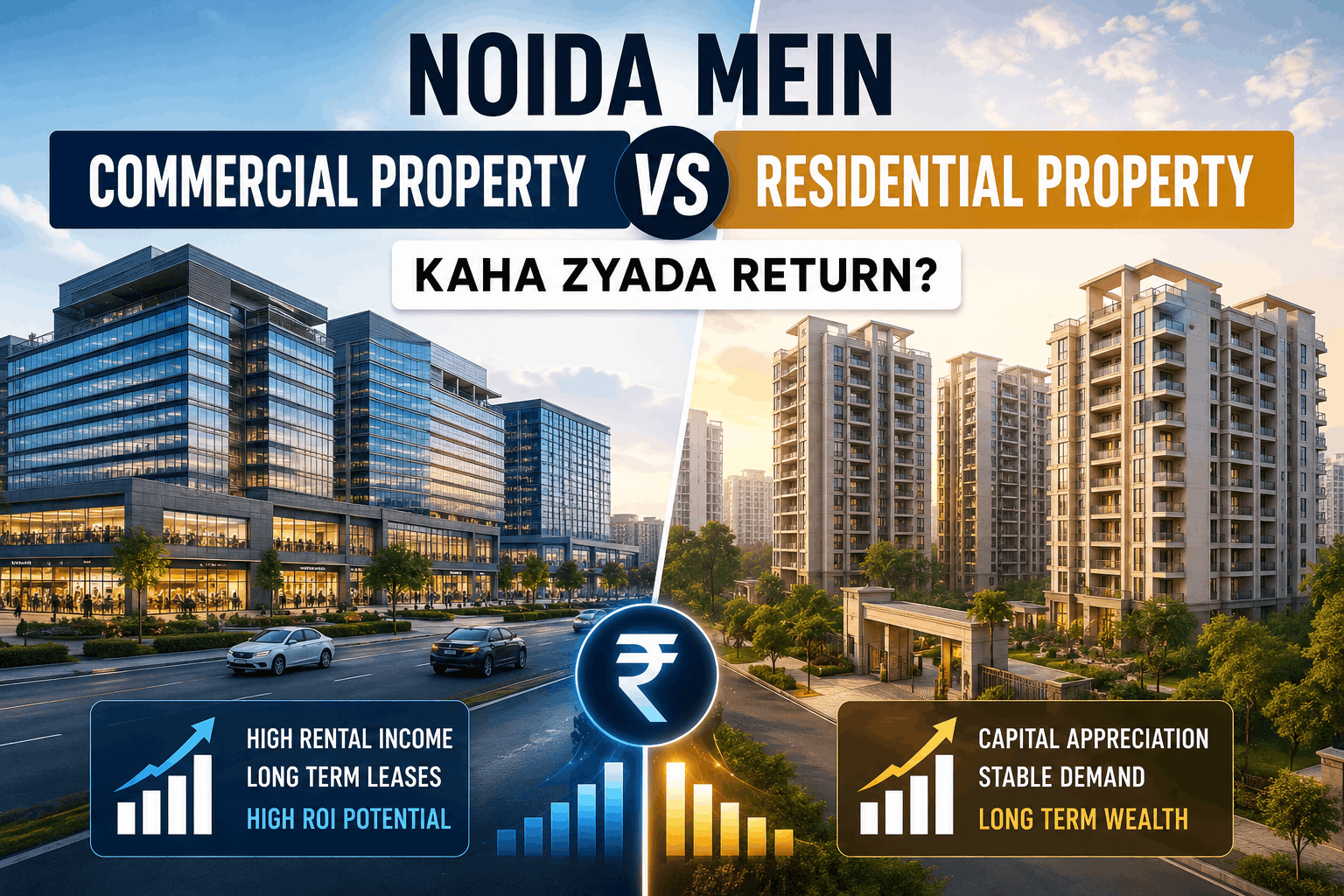
Key Takeaways
- Commercial yields significantly outperform residential metrics.
- Residential sectors hit peak short-term structural appreciation.
- Jewar Airport operationalization anchors future commercial validation.
- UP-RERA integration successfully purged legacy counterparty risks.
In our market observations across the Delhi NCR land landscape, assessing systemic capital yields requires stepping away from developer brochure hype and examining real audited numbers. For fifteen years, the regional real estate layout within Noida has shifted through aggressive speculative booms, complex liquidity crunches, and foundational regulatory corrections. Understanding the exact mechanical spread between residential expansion and commercial yields is critical for institutional allocators and retail investors aiming to maximize long-term deployment strategies.
Current institutional capital flows indicate a major rotation occurring away from simple land accumulation toward structured, yielding operational assets. To navigate this transformation safely, we must detail the distinct structural frameworks that built, stressed, and ultimately revitalized this primary economic engine.
The Structural Archeology of Noida's Land Framework
Originating in 1976 under the UP Industrial Area Development Act, the New Okhla Industrial Development Authority (NOIDA) was engineered as an administrative mechanism to systematically decongest Delhi's urban sprawl. Unlike Gurugram's private, freehold assembly model, Noida adopted an exclusive, state-managed leasehold allocation system structured around fixed 90-year tenures. This master-planned approach strictly controlled infrastructure zoning but introduced unique regulatory dependencies on bureaucratic deployment schedules.
Deconstructing the Great Residential Liquidity Reset
The explosive decade of the 2010s drew substantial capital into aggressive high-density housing developments, specifically throughout sectors clustering within Noida Extension. Driven by affordable alternative comparisons to Delhi's saturated core, large-scale projects were launched with highly speculative parameters. However, the absence of stringent capital allocation boundaries resulted in systemic project delays. Developers routinely diverted buyer advance allocations to acquire vast additional land inventories, triggering the historic credit and execution crises that frozen legacy builders like Amrapali and Jaypee.
The implementation of the Real Estate (Regulation and Development) Act of 2016 structurally transformed the region's capital cycles. The mandate of UP-RERA ring-fencing 70% of project liquid capital inside isolated escrow accounts eliminated highly leveraged operators. This institutional filtration cleared the path for well-capitalized corporate entities, restoring transparency and providing the foundation for modern ncr-real-estate development vectors.
| Investment Matrix Pillar | Residential Properties (2026) | Commercial Properties (2026) | }
|---|---|---|
| Average Annual Yields | 2.5% – 4.5% | 6.0% – 12.0% |
| Capital Growth Profile | Stabilized (5% – 7% long-term projection) | Steady Scaling (15% – 25% over 3 years) |
| Typical Lease Duration | 11 Months to 2 Years | 5 to 9 Years (Corporate Standard) |
| Systemic Vacancy Risk | Very Low (Constant demand absorption) | Moderate to High (Long tenant churn cycles) |
Current Yield Economics: The 2026 Asset Spread
Our field auditing indicates that the residential sector has experienced a massive pricing evolution post-2020. The structural market inventory overhang that historically peaked over 48 months has collapsed into a highly compact 17 months. The average value per square foot across prime central zones has expanded past ₹11,750, shifting the landscape entirely from an affordable hub to a mid-premium reality. Yet, this aggressive pricing expansion has compressed absolute rental yields, keeping standard residential cash returns tightly bounded near 3%.
Conversely, corporate office spaces and high-street retail properties along the ncr-real-estate corridors continue to operate as highly productive cash-flow generators. Backed by corporate relocations looking to capture lower operating rents relative to Gurugram's premium business towers, Grade-A commercial setups command solid rents. They produce clear net yields of 6% to 9%, while localized high-street retail shops targeting dense residential clusters frequently clear 10% to 12% absolute cash-on-cash returns.
The Infrastructure Catalyst Vectors
The systematic activation of regional infrastructure links has altered long-term pricing trajectories. The primary arterial spine of the Noida-Greater Noida Expressway, opened originally in 2002, unlocked vast institutional zones. This was accelerated by the transit connectivity of the Metro Blue and Aqua lines. Now, the full operational launch of Phase I at Jewar International Airport has decisively removed speculative uncertainty along the Yamuna Expressway corridor, converting raw land parcels into high-growth logistical hubs.
Strategic Investment Playbook for 2026 and Beyond
For investors aiming to optimize their asset allocation, diversifying away from standard capital growth plays is essential. Exploring stable allocation alternatives like property-investment-strategies requires specific risk management. While residential profiles are excellent for long-term equity preservation, commercial properties offer stronger cash compounding options. Retail investors can access these higher yields through modern corporate fractional ownership frameworks without needing massive independent capital outlays.
Perform Strict Correlative Due Diligence
Verify corporate developer compliance directly within the UP-RERA database before deploying capital to eliminate construction execution risks.
Evaluate the Asset's Environmental Integration
Prioritize Grade-A commercial developments that carry verified ESG certifications (LEED/IGBC) to retain long-term institutional multinational corporate tenants.
Analyze Total Cost Efficiency Metrics
Compare absolute common area maintenance charges against net localized rental income to guarantee net cash flow protection from inflation.
Frequently Asked Questions
1. How did the real estate market in Noida originally originate?
Noida was established in 1976 as an administrative industrial township under the UP Industrial Area Development Act to systematically absorb industrial growth and help decongest the neighboring national capital region of Delhi.
2. Why did residential real estate experience an explosive boom in the 2010s?
The expansion was driven by rapid corporate IT sector growth, significantly lower land entry thresholds compared to Delhi, and widespread speculative development across new sub-sectors like Noida Extension.
3. What systemic failures triggered the legacy housing crisis in Noida?
Unchecked developer expansion, structural loopholes, and the aggressive diversion of customer advance funds to purchase further land banks left thousands of homebuyers exposed to incomplete projects.
4. How did the legislative implementation of RERA alter the local investment market?
UP-RERA forced strict escrow funding accounts, required detailed project disclosures, and filtered out under-capitalized operators, significantly lowering transaction counterparty risk.
5. How do historical commercial property returns compare directly to residential returns?
Commercial assets consistently generated significantly stronger rental yields of 6% to 8% compared to the modest 2% to 3% baseline yields typical of the highly supplied residential apartment segment.
6. What is the modern financial significance of the Noida-Greater Noida Expressway corridor?
Opened in 2002, the Expressway transformed accessibility, turning adjacent sectors into premium institutional locations for Grade-A office campuses and master-planned residential communities.
7. What demographic historically formed the core buyer base for early Noida property?
The early buyer profile consisted heavily of middle-class corporate service professionals looking for affordable housing options, alongside local speculative investors trading land parcels.
8. How did Sector 62 actively shape the regional commercial landscape?
Sector 62 was developed as a dedicated institutional zone, proving the region's long-term commercial potential by securing major global technology firms and back-office campuses.
9. Why did early strata-sold shopping malls perform poorly in terms of absolute yield?
Strata-sold models divided ownership among fragmented retail buyers, which prevented unified management, consistent leasing strategy, and the retention of major anchor brands.
10. How did the expanding Blue and Aqua metro lines impact property valuations?
The transit expansion instantly boosted adjacent asset pricing by 15% to 20%, dramatically increasing occupancy rates and improving rental demand from the mobile corporate workforce.
11. What structural risks did early Yamuna Expressway land speculation encounter?
Early land purchases suffered from an absence of essential social infrastructure, keeping projects underutilized for a decade until the official development of the airport revived investor focus.
12. Why did multinational corporate occupiers historically favor Gurugram over Noida?
Gurugram offered freehold land structures and closer proximity to the international airport, which initially outweighed the lower operating cost advantage of Noida's leasehold system.
13. How did the COVID-19 pandemic disrupt relative real estate asset performance?
Remote work temporarily slowed corporate office leasing, while creating strong demand for larger residential configurations, sparking a luxury apartment pricing surge.
14. How has the massive regional inventory overhang been resolved over time?
Strong post-pandemic market absorption combined with tight controls on unapproved project launches cleared out the oversupply, stabilizing the market at a healthy 17-month inventory level.
15. Which real estate asset class is projected to deliver higher absolute returns by 2030?
Commercial real estate is positioned to lead overall returns via compounding 8% to 10% rental yields, while the residential sector stabilizes into a mature wealth preservation asset class.
Have a story idea, tip, or ask us for any project?
Submit your insights, real estate queries, story ideas, or project inquiries directly to our editorial team using our quick submission form.
Submit Your InquiryLooking for tailored advice?
Get in touch with our experts. We're here to help you navigate your queries and provide the best solutions.