
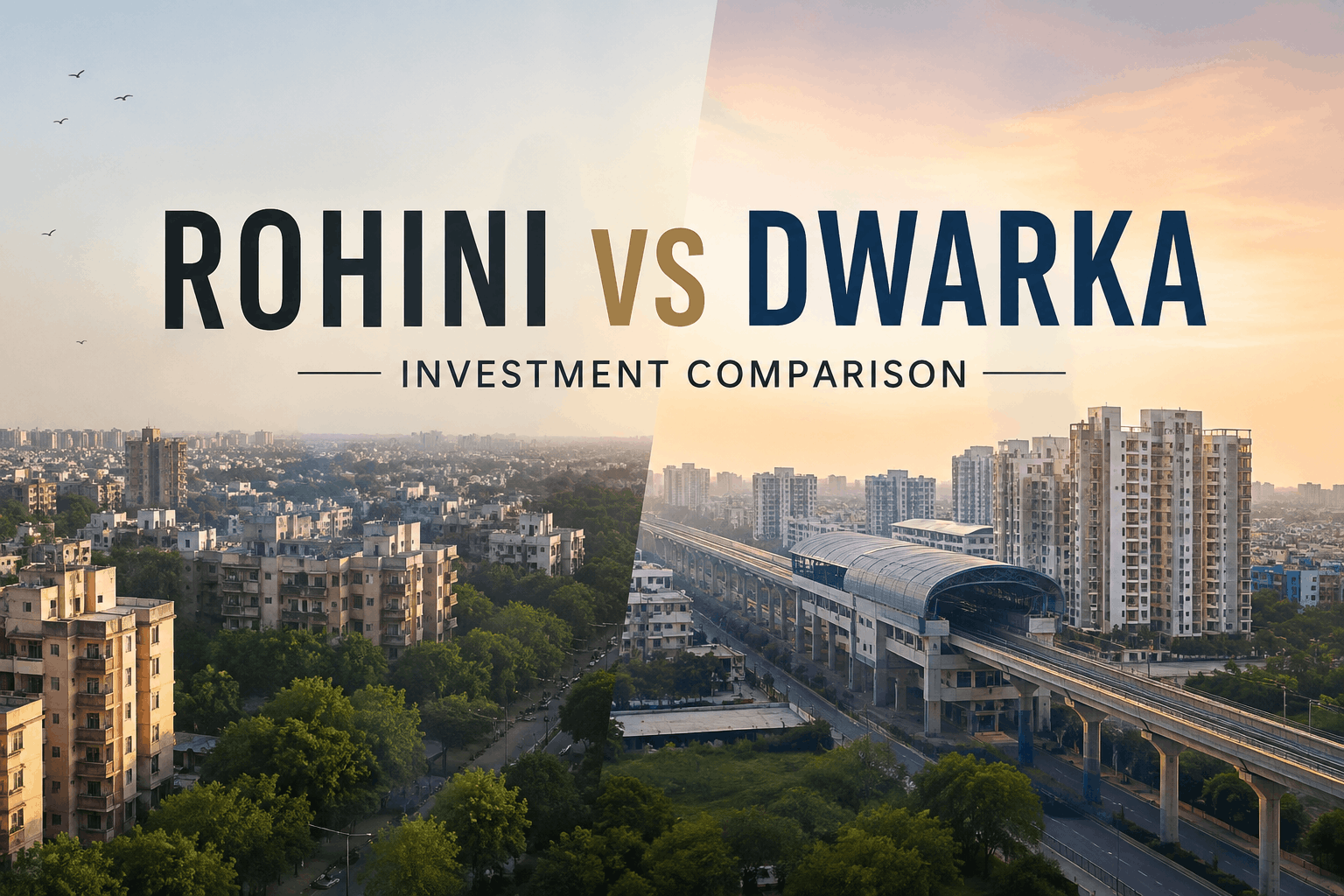
Rohini vs. Dwarka Real Estate: A Data-Driven Investment Guide for 2026
Key Takeaways
- Dwarka averages ₹15,450/sq ft, driven by airport and corporate proximity.
- Rohini averages ₹13,100/sq ft, fueled by traditional business communities.
- Dwarka offers higher rental yields at ~2.8% to 3.5%.
- Rohini allows independent plot redevelopment for multi-generational wealth.
- Yashobhoomi and UER-II are the primary 2026 infrastructure catalysts.
Allocating capital into the Delhi NCR real estate market requires clinical precision. As institutional investors pivot their strategies to hedge against inflation, two massive DDA-planned sub-cities constantly compete for retail and HNI capital: Rohini in the North West and Dwarka in the South West. The Rohini vs Dwarka real estate investment 2026 debate is no longer about raw land acquisition; it is a complex play on infrastructure maturity, demographic shifts, and the yield spread between residential and commercial assets.
In our market observations, retail investors frequently misunderstand the underlying mechanics of these two regions. They assume both are simply older "bedroom communities." This is mathematically false. Dwarka is actively transitioning into a globalized aerotropolis, while Rohini is undergoing a violent internal redevelopment cycle. To navigate this, we must examine the hard data points surrounding circle rates, master plans, and capital flows.
The Institutional Market View: Why NCR Sub-Cities are Surging
Between 2013 and 2019, both Rohini and Dwarka suffered prolonged price stagnation. Policy shocks like demonetization, the rollout of RERA, and massive oversupply in adjacent Noida and New Gurgaon drained liquidity from Delhi's secondary markets. However, the conversion of leasehold DDA properties to freehold status radically altered the capital structure here. Freehold status allowed owners to secure institutional banking finance easily, restoring immense liquidity to these micro-markets.
Today, high circle rates enforced by the Delhi government demand substantial "white-money" capital for registries, effectively filtering out short-term speculative flippers. You are now competing in a market dominated by end-users and serious, long-term investors. If you are exploring broad NCR real estate investment strategies, understanding the fundamental difference in land ownership between Dwarka and Rohini is your absolute first step.
| Market Metric (2026 Data) | Dwarka | Rohini |
|---|---|---|
| Average Property Rate | ₹15,450 / sq ft | ₹13,100 / sq ft |
| Average Rental Yield | 2.8% - 3.5% | 2.5% - 2.6% |
| Primary Housing Format | Cooperative Group Housing (CGHS) | Independent Plots / Builder Floors |
| Core Catalyst Project | Yashobhoomi IICC (Sector 25) | Urban Extension Road (UER-II) |
Dwarka Real Estate Market 2026: Capitalizing on the Aerotropolis Boom
Dwarka was originally conceptualized to alleviate central Delhi's housing crunch, aggressively targeting educated service-sector professionals. Today, that foundation has evolved. Dwarka boasts unparalleled multi-line transit connectivity—the Blue Line forms its spine, the Airport Express provides ultra-fast access to New Delhi Railway Station, and the Magenta Line links directly to South Delhi.
The true alpha in Dwarka right now surrounds Sector 25. The completion of the Yashobhoomi (IICC) convention center has placed Dwarka on the global map. Areas immediately adjacent are experiencing aggressive institutional inquiries for luxury hotels, grade-A office spaces, and serviced apartments. Concurrently, the development of the Second Diplomatic Enclave in Sector 24 is drawing high-security infrastructure, pulling an elite, ultra-wealthy demographic into the sub-city.
Rohini Real Estate Market 2026: The Power of Independent Plots & UER-II
Rohini's DNA is entirely different. Historically appealing to traditional business families and traders, the DDA allocated vast tracts of land here for individual plot buyers. This demographic values absolute autonomy over the regulated environment of cooperative societies. The current dominant trend in Rohini is the violent redevelopment of old, single-story homes into luxurious 4-story builder floors featuring stilt parking and smart-home technology.
While Dwarka represents stable wealth preservation, Rohini represents aggressive capital growth—if you know where to deploy. The Urban Extension Road (UER-II) is acting as a massive price driver, bridging the geographical gap between North and South West Delhi. It is slashing commute times to the airport and Gurgaon from over 90 minutes down to roughly 30 minutes, unleashing a fresh wave of speculative capital into Rohini’s delayed newer sectors (Sectors 34-38).
Rental Yields vs. Capital Appreciation: The Quantitative Split
If you are evaluating commercial vs residential yields, the numbers dictate your strategy. Dwarka currently offers slightly better residential rental yields (up to 3.5%) because of the massive influx of transient corporate professionals working in Gurgaon and Aerocity. The presence of CGHS means maintenance and security are managed collectively, offering a hands-off, stable asset for absentee landlords.
However, commercial real estate in the Dwarka Expressway vicinity is heavily underpriced relative to its potential. While residential yields hover at 2-4%, commercial assets on this corridor are delivering rental yields of 6-7% annually. Rohini, conversely, offers the unmatched long-term benefit of independent land ownership. As zoning laws relax and Floor Area Ratios (FAR) increase over the next decade, a plot owner in Rohini can continuously rebuild and expand their asset. It is a multi-generational wealth-building mechanism that Dwarka's fractional ownership cannot match.
Debunked Industry Myth: "Dwarka is Only for End-Users"
A persistent myth propagated by casual brokers is that Dwarka is entirely saturated and only suitable for end-users buying older flats. This is a severe miscalculation. The integration of the Yashobhoomi complex and the upcoming international business district has transformed Dwarka into a primary employment generator. It is transitioning from a feeder suburb into a self-sustaining economic node. Forward-looking capital is aggressively targeting commercial assets and short-term rental models (Airbnbs, serviced apartments) near Sector 25, anticipating massive international footfall.
Step-by-Step Strategic Entry: How to Allocate Capital
Deploying capital requires a structured framework to mitigate structural risks and optimize tax efficiency. Follow this exact workflow before liquidating your capital.
Determine Asset Control Preference
Decide if you want a "hands-off" managed asset (choose Dwarka CGHS apartments) or if you want absolute redevelopment control over the physical land (choose Rohini independent plots).
Conduct Structural & Civic Audits
If buying in Dwarka, demand a recent structural audit of the late-90s society building. If buying in Rohini, physically inspect the sewage and parking capacity of the specific street, as aggressive builder-floor conversions frequently overwhelm older plumbing.
Optimize Capital Gains Taxation
Ensure your purchase aligns with Section 54/54F exemptions if rolling over previous property sale profits. Consult our guide on understanding capital gains tax exemptions to prevent severe tax leakage during portfolio reallocation.
Frequently Asked Questions
Which sub-city currently commands higher property rates in 2026?
Dwarka currently commands a premium, with average property rates hovering around ₹15,450 per sq ft compared to Rohini’s average of ₹13,100 per sq ft.
How has the Yashobhoomi (IICC) project impacted Dwarka's real estate?
The Yashobhoomi convention center in Sector 25 has driven immense commercial and hospitality demand, spiking capital values in adjacent sectors by up to 32% year-over-year.
What is the primary infrastructure driver for Rohini's future growth?
The Urban Extension Road (UER-II) is the primary driver, drastically cutting commute times to the airport and unlocking the value of Rohini's historically delayed outer sectors (34-38).
Who are the core demographics buying in Dwarka?
Dwarka primarily attracts educated service-sector professionals, aviation staff, corporate executives from Gurgaon, and expats utilizing the diplomatic enclaves.
Who are the core demographics investing in Rohini?
Rohini continues to attract traditional business families, traders, and multi-generational households prioritizing independent plotted floors over gated society living.
Which location offers better residential rental yields?
Dwarka offers slightly better rental yields (around 2.8% to 3.5%) driven by transient corporate professionals, compared to Rohini’s roughly 2.5% yield.
Are there high-yield commercial investments available in these markets?
Yes, Dwarka Expressway and Sector 25 commercial assets are currently delivering rental yields of 6-7% annually, significantly outpacing standard residential properties.
What are the structural risks of investing in older Dwarka societies?
Many CGHS apartments from the late 90s are showing severe structural wear, requiring expensive maintenance audits. Redevelopment frameworks for these complexes are urgently necessary.
What are the infrastructural challenges facing Rohini today?
Rampant conversion of single-family plots into dense 4-story builder floors has severely strained Rohini’s original plumbing, parking, and sewage infrastructure, risking future urban decay.
How does Metro connectivity compare between Rohini and Dwarka?
Dwarka boasts superior multi-line access (Blue Line, Magenta Line, Airport Express). Rohini relies primarily on the older, heavily crowded Red Line.
What is the impact of the Diplomatic Enclave II on Dwarka?
Sector 24's Diplomatic Enclave is introducing an elite, high-security zone, driving intense demand for ultra-luxury housing and expat-focused amenities in the vicinity.
Why did property prices stagnate in these areas during the 2010s?
A combination of demonetization, RERA implementation, GST rollouts, and a massive oversupply in adjacent Noida and Gurgaon suppressed capital appreciation in the 2010s.
How will the Master Plan 2041 affect Dwarka?
MPD-2041 will likely promote mixed-use developments, allowing higher Floor Area Ratios (FAR) and integrating nighttime economy hubs aligned with the Yashobhoomi infrastructure.
How will Master Plan 2041 transform Rohini?
MPD-2041 emphasizes Transit-Oriented Development (TOD) and land pooling, which will accelerate the urbanization of Rohini’s rural peripheries and encourage high-density commercial skyscrapers.
Which asset class in Rohini is the most liquid right now?
Newly constructed, 4-story independent builder floors with stilt parking represent the most liquid and highly transacted asset class in the Rohini secondary market.
Have a story idea, tip, or ask us for any project?
Submit your insights, real estate queries, story ideas, or project inquiries directly to our editorial team using our quick submission form.
Submit Your InquiryLooking for tailored advice?
Get in touch with our experts. We're here to help you navigate your queries and provide the best solutions.